Machine learning · Bayesian statistics · Advanced mathematics
Probabilistic forecasts for Australian questions, with the working shown.
Elections, the economy, sport and the housing market. We forecast them as full probability distributions and publish our methods, our data and our track record. Every release is timestamped and archived. Nothing is revised after the fact.
Live now
Forecasts currently being published. Each panel shows when it last changed, what triggers its next update and its next scheduled release. Event forecasts such as elections leave this section once they are scored. Standing forecasts stay for as long as they run.
Live
Victoria88-26: the 2026 Victorian state election
Our forecast covers all 88 Legislative Assembly electorates. It pools every published state poll, works out where each party's vote sits across the electorates, and will simulate the preference count in every seat. It never uses a two-party-preferred figure.
We are releasing it in stages. First-preference estimates for every party in every electorate are published now, each with its plausible range. Win probabilities follow once nominations close on 9 November and the how-to-vote cards are registered. In December every published figure is scored against the result, misses included.
Release schedule
- Now First-preference estimates Every party, all 88 electorates
- After 9 November Win probabilities and seats Once the how-to-vote cards are registered
- 28 November Polling day
- December 2026 Post-election diagnostics Every release scored against the result
What we forecast
Our four verticals and where each one stands.
Live
Elections
One Bayesian model for Australian lower-house elections. It pools the polls, distributes the vote across electorates and simulates the preference count. Victoria 2026 is its first application.
Under construction
Economics
The RBA meeting by meeting, CPI nowcasts from live prices and the capital-city petrol cycle. The numbers households actually feel.
Planned
Sport
Hierarchical team-strength models for the AFL, NRL and Big Bash. Win probabilities, ladder simulation and finals odds.
Planned
Real Estate
Auction clearance nowcasts each Saturday, and hierarchical models of prices and rents at suburb level.
Analysis
Our first series leads into the Victorian election.
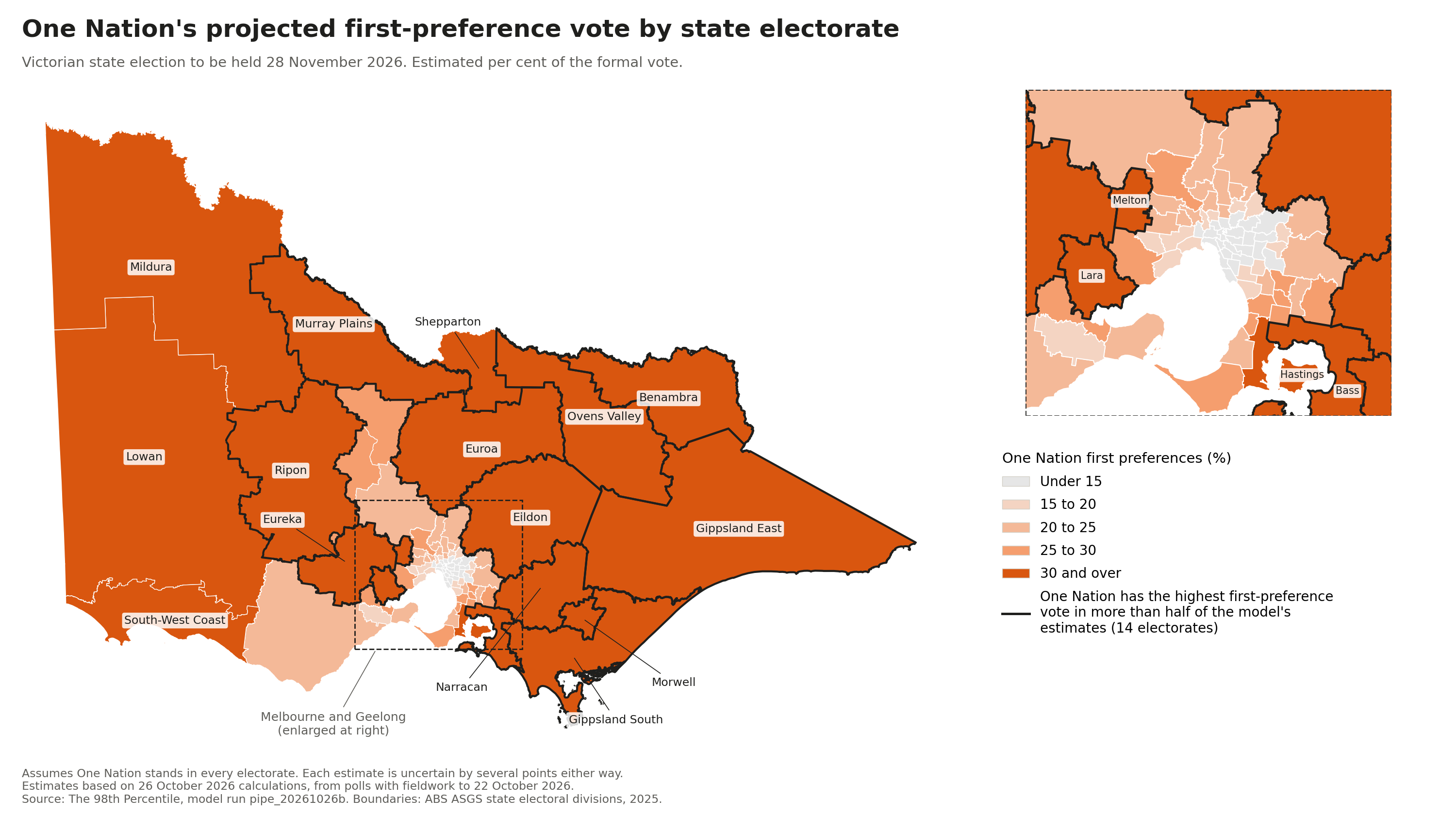
New
The rapid rise of One Nation in Victoria
One Nation won just under 6 per cent of the Victorian vote at the 2025 federal election. It is now polling about four times that, enough to give it the highest first-preference vote in 14 of the 88 electorates.
Read the analysis →Forthcoming
Video: One Nation's Victoria, electorate by electorateVideo